RESEARCH AREAS

Ion Transport Through Nanopores

Electrical Double Layer Capacitors (EDLCs)
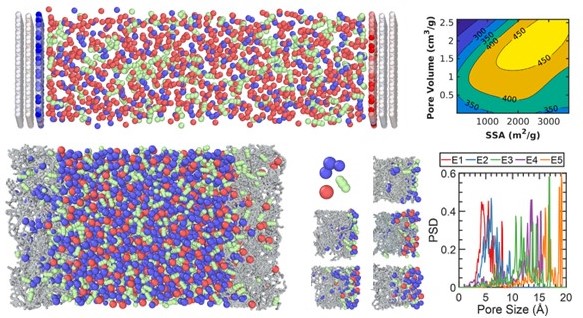
Our group studies how ions behave when they are squeezed into tiny pores only a few nanometers wide. Using advanced molecular simulations, we uncover how pore size, ion size, and solvent structure work together to control charge storage. These insights help explain why some nanoporous materials store energy more efficiently than others and guide the rational design of next-generation supercapacitors with higher performance and lower energy losses.

Capacitive Deionization (CDI)

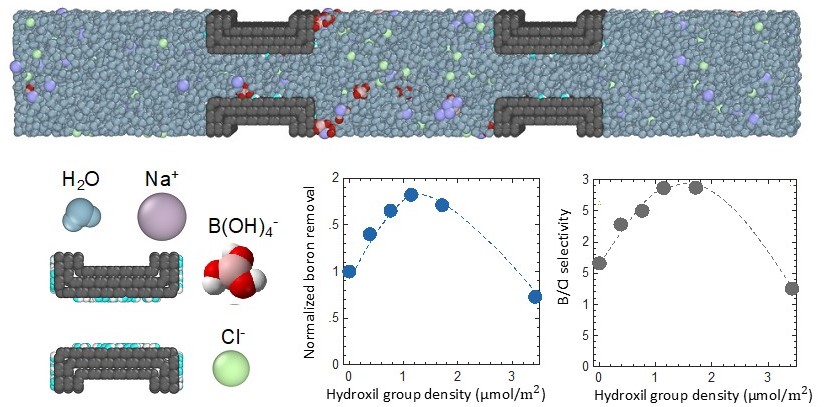
We investigate how chemical functional groups inside nanoporous electrodes selectively attract and remove specific ions from water. By visualizing ion–surface interactions at the atomic scale, we reveal why certain materials capture challenging species, such as boron, much more effectively. This molecular-level understanding enables mechanism-driven design of energy-efficient desalination and water-treatment technologies.

Biological Ion Channels

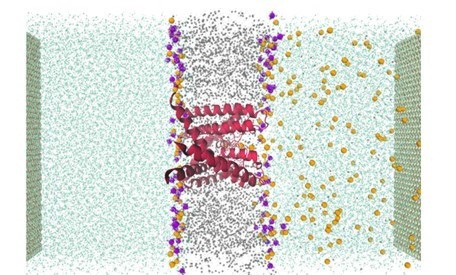
Nature has evolved ion channels that discriminate between ions with extraordinary precision. We use rare-event sampling and atomistic modeling to explore how these channels guide preferred ions while excluding others. By uncovering the chemical and structural motifs responsible for biological selectivity, we aim to translate these principles into biomimetic synthetic nanopores for separation, sensing, and energy applications.

Conformational Transitions in Proteins

Protein Folding Kinetics
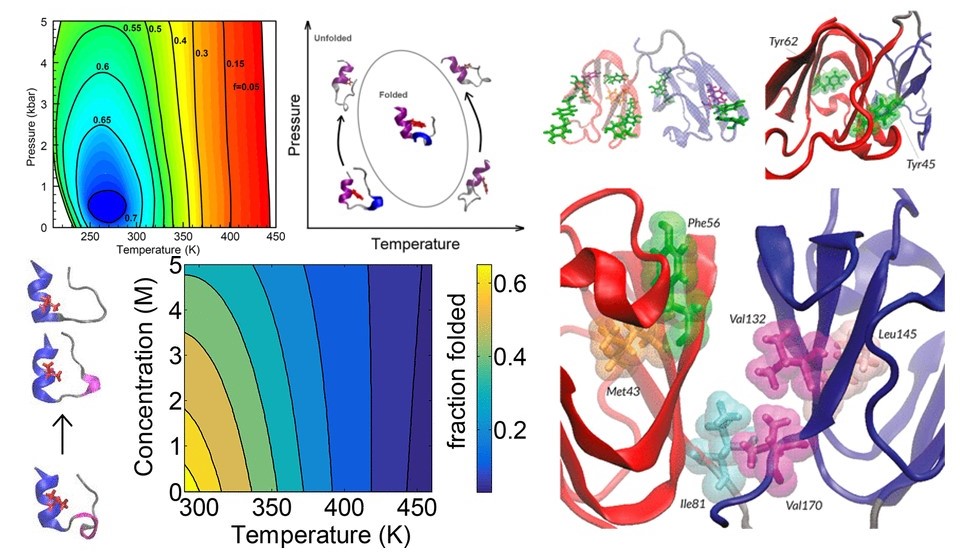
Proteins constantly shift between folded, partially folded, and unfolded states. We use advanced sampling techniques to map the energy landscapes that govern these transitions and to identify the molecular events that trigger folding or unfolding. Our work illuminates why some proteins remain stable under extreme conditions while others misfold, offering clues into the origins of diseases linked to protein instability.

Conformational Transitions Under Environmental Perturbations
Temperature, pressure, and chemical environments can dramatically reshape a protein’s structure. Through detailed simulations, we quantify how these perturbations alter folding pathways revealing, for example, how cold, heat, or high pressure can converge to produce similar unfolded states. These findings help connect fundamental thermodynamics with practical challenges in biotechnology, biophysics, and drug formulation.

Mutational Dynamics in γD Crystallins
Human γD-crystallin is a long-lived eye-lens protein whose destabilization is associated with cataract formation. We study how mutations or environmental stresses reorganize its conformational landscape, revealing hidden intermediate states that may act as precursors to protein aggregation. This molecular insight strengthens our understanding of age-related eye diseases and informs efforts to design stabilizing strategies.
Complex Phase Behavior in Fluids
Research Figure

Phase Behavior in Chiral Mixtures

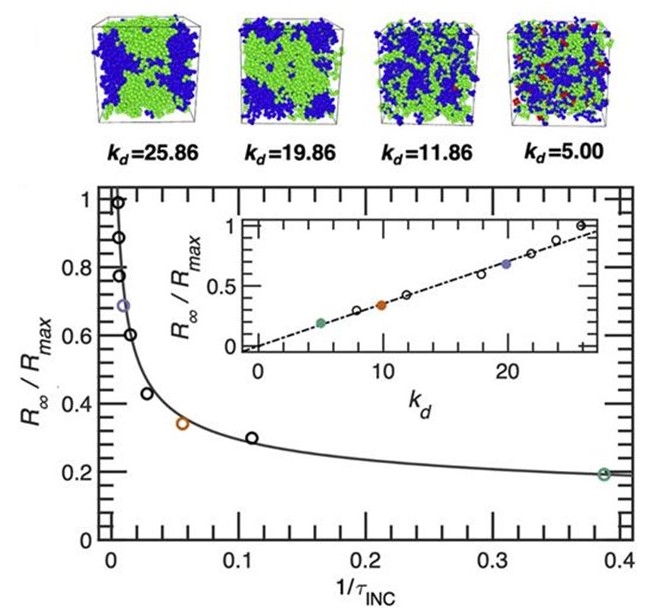
Chiral molecules, those that exist in left- and right-handed forms, can undergo complex phase separation when they interconvert or mix asymmetrically. We develop computational models that capture how chirality and molecular transformations influence fluid behavior, producing rich, often unexpected multiphase structures. This work provides fundamental insight into self-assembly, biomolecular condensates, and soft materials whose properties respond to subtle chemical changes.